
Stanley Royle
Sheffield Artist in the Mayfield Valley and neighbourhood

Stanley Royle is one of my favourite Sheffield Artists. I only recently learned that for a time, he lived just down the road from where I live. He moved to the Fulwood area shortly after the birth of his daughter, Jean. His wife may have suffered from what would now be known as post-natal depression. The following is taken from the 2008 “Stanley Royle Catalogue of his works” by Timothy Dickson
“…….Requiring a place of their own, Stanley rented a cottage at Bole Hill Farm, Fulwood, on the edge of the Mayfield Valley in the summer of 1916. The tranquillity of the rural location was chosen to ameliorate Lily’s bouts of ill-health. However the area also offered him the ideal location in which to produce his most accomplished works to date. In the spring of 1918, Royle and his family moved again, this time to a larger cottage at Whiteley Wood Green. Across the valley from Bolehill Farm. The Royles lived cheek-by-jowl with farm labourers who worked at Priest Hill Farm. The farm buildings and nearby cottages at Whiteley Wood Green became central to his work. His paintings depicted the daily toil of farm labourers, teams of plough horses, and the cattle, sheep and chickens on various neighbouring farms. Despite living on a farm, he would buy many of his groceries from Broughton’s at Ranmoor, a quality grocers and wine merchants. Often, he would have little or no income and would settle his outstanding debt by exchanging a canvas against his monthly account……”
The footnote relating to the above, indicates that the cottage the Royle’s lived in on Whiteley Wood Common between 1918 and 1926 was one of several pulled down between the wars and that William Henry Broughton Grocers and wine Merchants was situated at 376 & 380 Fulwood Road. The information was provided by the artist, Frank Constantine in an interview in October 1996.
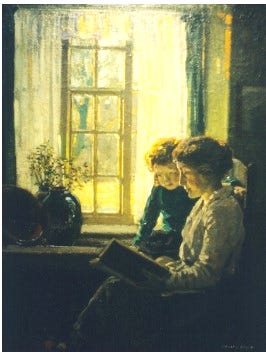
The above painting shows Stanley Royle’s wife, Lily, and his daughter Jean. The cottage could be either the one at Bole Hill, or the Whiteley Wood Green cottage.
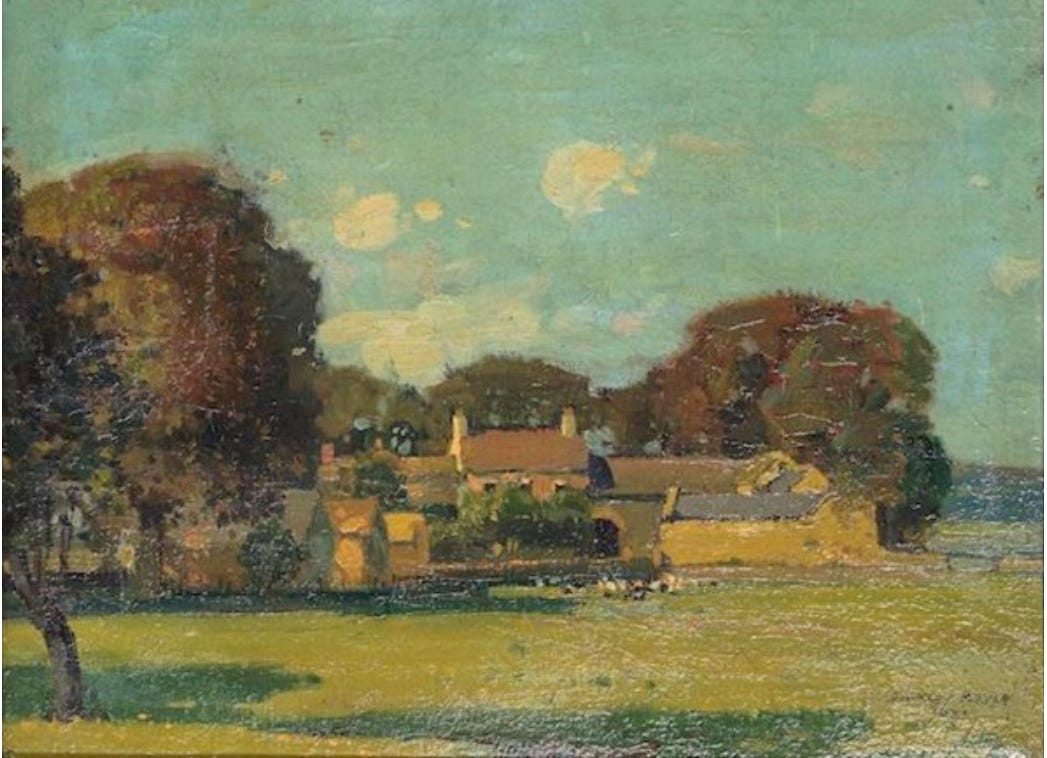
Priest Hill Farm is shown in the next painting dated 1921. It was entitled ‘A Cottage in the Mayfield Valley’.
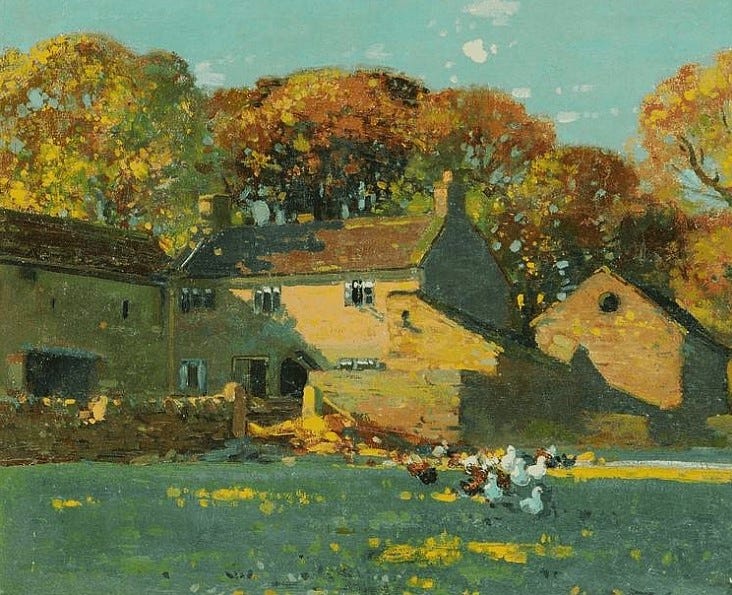
Stanley Royd painted many views of ‘The Homestead” some are of Priest Hill Farm, but the next one is Meadow Lane Farm, on Whiteley Wood Road, called ‘the Homestead Autumn’ and was painted ion 1921/2
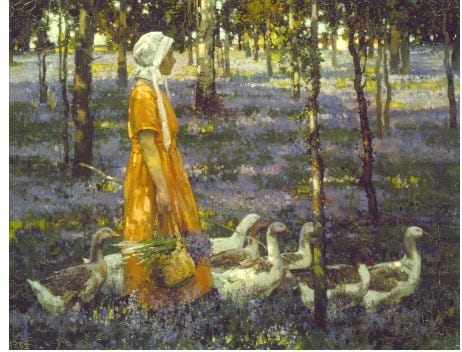
Ducks, geese, and chickens are a recurrent feature of Stanley Royd’s work. My favourite local painting by him includes geese and is entitled ‘The Goose Girl’. She is likely to have been his wife, Lily driving the geese through the Whiteley Woods bluebells. Earlier in 1924 he produced a watercolour of her entitled ‘Lily Carrying Bluebells in Whiteley Woods. Below is ‘the Goose Girl.’
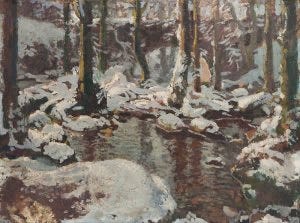
Whiteley Woods appear in several paintings from 1924. ‘Fording the Stream’ and ‘The Stream in Winter’ both show bridges over the river Porter where Hangingwater Road crosses the river to Highcliffe Lane. ‘Whiteley Woods in Snow’ however shows the wood itself.
Stanley Royle (1888-1961) was a post-impressionist artist. Sheffield’s Weston Park Museum has a particularly good example of his work. Many of the canvases showing features from the Mayfield Valley which have, at one time, been exhibited do not have any current photographs of them so could not be illustrated in the 2008 catalogue of his works. I would like to try to identify which of his paintings made between 1916 and 1926 show identifiable features of this area. There are around 100 works that may fall into this category. This short article is part of this project, and I would welcome information from anyone who owns any of his local works (or knows someone who does!)